
The sine is simply a RATIO of certain sides of a right triangle. Look at the triangles below. They all have the same shape. That means they have the SAME ANGLES but the lengths of the sides may be different. In other words, they are SIMILAR figures.
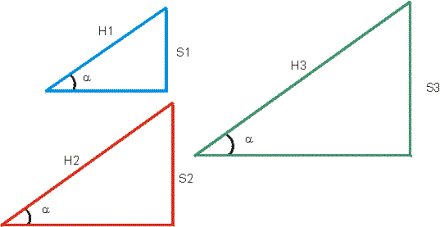
Have your child/students measure the sides s1, h1, s2, h2, s3, h3 as accurately as possible (or draw several similar right triangles on their own).
| Then let her calculate the following ratios: | s1 --- , h1 |
s2 --- , h2 |
s3 --- . h3 |
What can you note? |
Those ratios should all be the same (or close to same due to measuring
errors). That is so because the triangles have the same shape (or are similar),
which means their respective parts are PROPORTIONAL. That is why the ratio of
those parts remains the same. Now ask your child what would happen if we had a
fourth triangle with the same shape. The answer of course is that even in that
fourth triangle the ratio s4/h4 would be the same.
The ratio you calculated is associated with the angle a that all of those
triangles had the same. THAT RATIO IS CALLED THE SINE OF THE ANGLE a.
| s1 --- = h1 |
s2 --- = h2 |
s3 --- = h3 |
sin a =0.57358 |
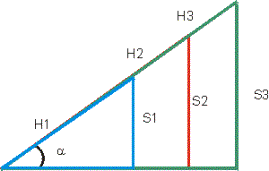
In our pictures the angle a is 35 degrees. So sin 35º = 0.57358 (rounded to
five decimals). We can use this fact when dealing with OTHER right triangles
that have a 35º angle. See, other such triangles are, again, similar to these
ones we see here, so the ratio of the opposite side to the hypotenuse, WHICH IS
THE SINE OF THE 35 ANGLE, is the same! So in another such triangle, if you only
know the hypotenuse, you can calculate the opposite side since you know the
ratio, or vice versa.
Help with grade 7-12 math / science classes!
 Awesome
Grades in Math and Science Awesome
Grades in Math and ScienceAwesome Grades in Math and Science has helped thousands of students to develop good study habits, get motivated, build self-confidence, and achieve lasting success in math and science. I feel it's an excellent book for all students, whether home-schooled or in public/private school. Read a review of the book. |
Suppose we have a triangle that has the same shape as the triangles above.
The side opposite to the 35º angle is 5 cm. How long is the hypotenuse?
SOLUTION: Let h be that hypotenuse. Then
| 5 cm ------ = h |
= sin 35º | ~ 0.57358 |
From this equation one can easily solve that
| h = | 5cm ----------- 0.57358 |
~ 0.8.72 cm |
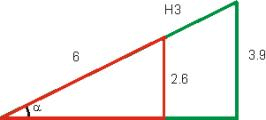
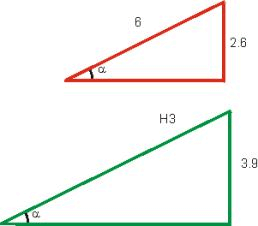
The two triangles are pictured both overlapping and separate. We can find H3 simply by the fact that these two triangles are similar. Since the triangles are similar,
|
3.9 --- = h3 |
2.6 --- 6 |
from which h3 = | 6 x 3.9 -------- = 2.6 |
9 |
We didn't even need the sine to solve that, but note how closely it ties in with
similar triangles.
The triangles have the same angle a. Sin
a of course would be the ratio
| 2.6 --- 6 |
or |
3.9 --- 9 |
~ 0.4333 |
Now we can find the actual angle a from the calculator:
Since sin a =0.4333, then a = sin-1(0.4333)
~ 25.7 degrees.
1. Draw a right triangle that has a 40º angle. Then measure the opposite side and the hypotenuse and use those measurements to calculate sin 40º. Check your answer by plugging into calculator sin 40º (remember the calculator has to be in the degrees mode instead of radians mode).
2. Draw two right triangles that have a 70º angle. Use the first triangle to calculate sin70º. Then measure the hypotenuse of your second triangle. Use sin70º and the measurement of the hypotenuse to find the opposite side. Check by measuring the opposite side from your triangle.
3. Draw a right triangle that has a 48º angle. Measure the hypotenuse. Then use sin 48º and your measurement to calculate the length of the opposite side. Check by measuring the opposite side from your triangle.
| Someone asked me once, "When I type in sine in my graphic calculator, why
does it give me a wave?" Read my answer where we get the familiar sine wave. |